Have you ever noticed that the most outrageous content online often spreads the fastest?
The posts that make us angry.
The videos that make us outraged.
The headlines that make us immediately want to argue in the comments.
That’s not an accident.
In today’s social media environment, outrage has become a business model.
What Is Rage Bait?
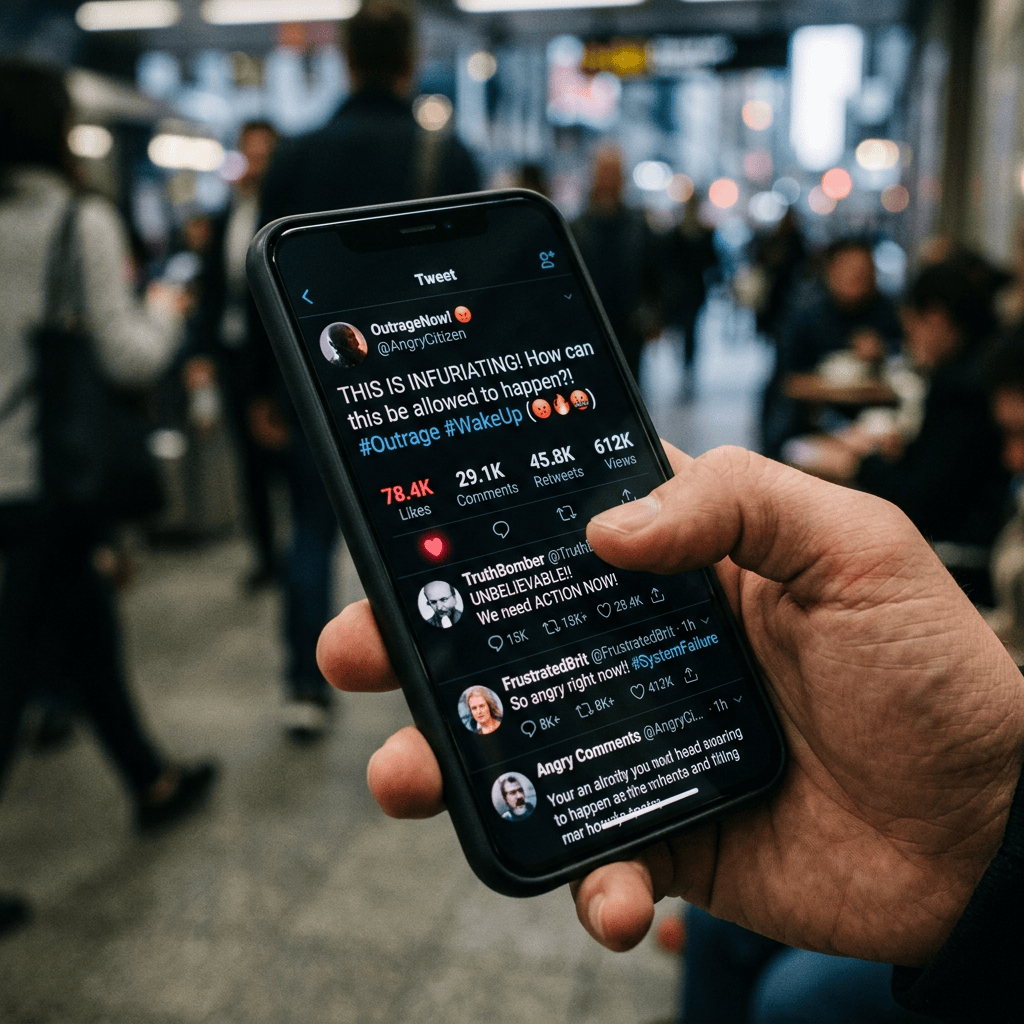
Rage bait is content specifically designed to provoke an emotional reaction—usually anger, frustration, or outrage.
The goal is not necessarily to inform.
The goal is engagement.
Creators understand that angry people are more likely to:
- Comment
- Share
- React
- Quote-post
- Create response videos
- Argue in the comments
Every one of those actions signals engagement to social media algorithms.
And engagement is often rewarded with greater visibility.
In other words, the more upset people become, the further the content travels.
The Algorithm Doesn’t Care Why You Engage
One of the biggest misconceptions about social media is that platforms reward quality.
Most algorithms don’t measure truthfulness.
They measure activity.
The algorithm generally doesn’t know whether a post is:
- Accurate
- Misleading
- Satirical
- Outrageous
- Completely false
It simply sees engagement.
A thousand people commenting “This is ridiculous!” often looks the same as a thousand people commenting “This is amazing!”
Either way, the content receives more attention.
When Misinformation Becomes Profitable
This creates a dangerous incentive.
If outrage generates engagement, and engagement generates views, followers, advertising revenue, sponsorships, and influence, then misinformation can become financially rewarding.
Some creators may not intentionally spread false information.
Others may fail to verify claims before posting.
Still others may understand that controversial or misleading content attracts attention and continue publishing it because it works.
The result is the same:
False or misleading information spreads faster than careful, nuanced reporting.
Why Corrections Rarely Catch Up
There is an old saying in journalism:
“A lie can travel halfway around the world before the truth puts its shoes on.”
The same principle applies online.
The original claim receives:
- Shares
- Reactions
- News coverage
- Response videos
Days later, a correction appears.
Unfortunately, the correction rarely receives the same level of attention as the original claim.
Many people remember the accusation but never see the correction.
As a result, misinformation can continue circulating long after it has been debunked.
The Responsibility of Content Creators
Social media influencers occupy a unique position in modern media.
Many have audiences larger than local newspapers and television stations.
With that influence comes responsibility.
Before publishing information, creators should ask:
- Is this verified?
- What is my source?
- Could this be misleading?
- Am I reporting facts or speculation?
- Would I publish this if it generated no engagement?
These questions are not barriers to free speech.
They are basic standards of responsible communication.
The Responsibility of Audiences
Consumers also play a role.
Every click, comment, share, and reaction teaches algorithms what to promote.
Before engaging with outrage-driven content, consider:
- Who benefits from my reaction?
- Is this information verified?
- Am I sharing facts or emotions?
- Am I helping spread information or simply spreading outrage?
Media literacy has never been more important.
Outrage Is Not Evidence
One of the greatest challenges facing modern society is learning to distinguish emotional reactions from factual information.
A post that makes us angry is not automatically true.
A viral video is not automatically credible.
A large following is not proof of expertise.
The internet has made it easier than ever to publish information.
It has also made it easier than ever to profit from misinformation.
In an attention economy, outrage is valuable.
That is exactly why consumers must learn to recognize when they are being manipulated.
The next time a post immediately makes you angry, ask yourself a simple question:
Was this designed to inform me—or was it designed to make me react?
When Influencers Become Journalists: The Accountability Gap in Modern Media