Author: RJ Hunter Holdings LLC

  • Facebook memories will humble you. 😂

    Facebook memories will humble you. 😂

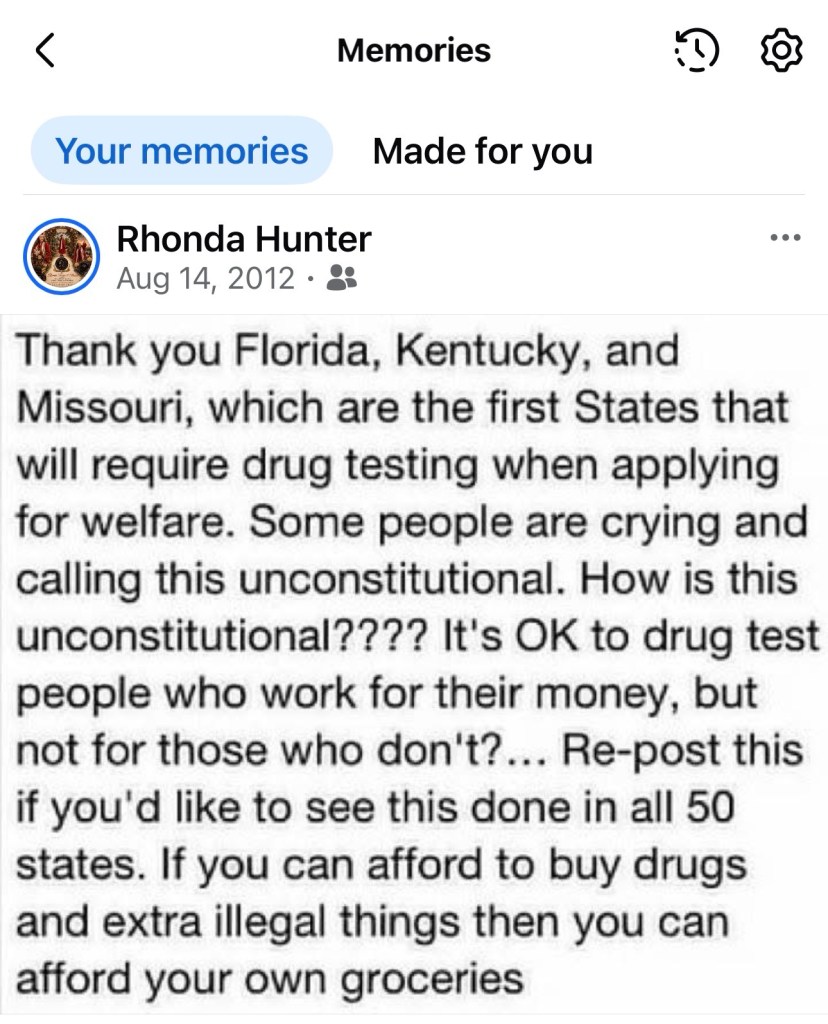
    This popped up from 14 years ago, and I sat here looking at it thinking about how much my thinking has changed.

    At the time, I had no problem with drug testing people who received public assistance. My reasoning was pretty simple: people get drug tested for jobs, so why shouldn’t someone receiving taxpayer-funded assistance be tested too?

    And no, I didn’t believe everyone receiving assistance was using drugs. It just seemed like a reasonable requirement.

    But here’s what I wasn’t asking:

    How much does all that drug testing cost taxpayers?

    How many recipients actually test positive?

    How much money are we supposedly saving after paying to administer an entire testing program?

    And most importantly, even if somebody IS struggling with drug addiction, when did that mean they no longer deserve to eat?

    That’s the part that hits me differently today.

    We’re talking about people receiving a relatively small amount of assistance to buy FOOD. Not cash for a vacation. Not some luxurious lifestyle. Food.

    Addiction doesn’t eliminate hunger. Poverty doesn’t eliminate someone’s humanity. And children certainly shouldn’t go hungry because of something their parent may or may not have done.

    What’s interesting to me about this memory isn’t that I suddenly became smarter sometime during the last 14 years. It’s that I learned to ask more questions.

    The meme gave me a very simple fairness argument:

    “If workers have to take drug tests, welfare recipients should too.”

    And I accepted the premise without examining everything underneath it.

    Who created that framing?

    What does the actual data say?

    What does the policy cost?

    Does it accomplish what we’re being told it accomplishes?

    Who benefits from convincing us that another struggling person is the problem?

    That’s what media literacy does. It doesn’t tell you what political opinion you’re supposed to have. It teaches you to stop accepting somebody else’s premise before you’ve examined it.

    Sometimes growth is being able to look at something you posted 14 years ago and say:

    I understand exactly why that argument made sense to me then. I also understand why it doesn’t anymore.

  • Social Media Doxxing: When Online Arguments Become Real-World Risks

    Social Media Doxxing: When Online Arguments Become Real-World Risks

    The internet has made it easier than ever to connect with people around the world. Unfortunately, it has also made it easier to target them.

    One of the most concerning trends in online culture is doxxing—the act of searching for and sharing someone’s personal information without their consent. While motivations vary, the goal is often the same: to intimidate, embarrass, punish, or silence someone.

    What begins as a disagreement on social media can quickly escalate into a search for personal details that have nothing to do with the original conversation.

    What Is Doxxing?

    Doxxing occurs when someone gathers and publicly shares private or identifying information about another person.

    This may include:

    • Full legal names
    • Home addresses
    • Phone numbers
    • Email addresses
    • Workplace information
    • Family member information
    • Financial details
    • Personal photographs
    • Court records or historical records

    Sometimes the information is published publicly. Other times it is sent to employers, family members, friends, or online communities in an attempt to create consequences for the targeted individual.

    Why People Doxx Others

    Contrary to popular belief, doxxing is rarely about public safety.

    More often, it is about power.

    When someone cannot win an argument, they may try to shift attention away from the discussion and onto the person making it.

    The goal becomes:

    “If I can’t defeat your argument, I will try to damage your reputation.”

    Political discussions, social issues, gaming communities, fandoms, and local community groups have all become common environments for this behavior.

    The Hidden Dangers

    Many people underestimate the risks associated with sharing personal information online.

    Once identifying information is released, it can spread rapidly across platforms and communities.

    Potential consequences include:

    • Harassment
    • Threats
    • Stalking
    • False reports
    • Employment issues
    • Emotional distress
    • Safety concerns for family members

    In extreme cases, doxxing has led to real-world confrontations and criminal investigations.

    What begins as an online dispute can quickly leave the digital world.

    Public Information vs. Ethical Behavior

    One of the most common defenses used by people who engage in doxxing is:

    “The information was already public.”

    While information may be publicly accessible, that does not automatically make it ethical to collect, compile, and distribute it for the purpose of targeting someone.

    There is a significant difference between information existing somewhere online and someone intentionally gathering it to intimidate another person.

    The question is not simply whether information is public.

    The question is how and why it is being used.

    Protecting Yourself Online

    No one can eliminate all risk, but there are steps that can reduce exposure:

    Review Privacy Settings

    Regularly audit social media accounts and limit the visibility of personal information.

    Remove Unnecessary Personal Details

    Avoid posting addresses, phone numbers, daily routines, or location-specific information.

    Separate Personal and Professional Identities

    When appropriate, consider maintaining separate accounts for personal and professional use.

    Monitor Your Digital Footprint

    Search for your own name periodically to understand what information is publicly visible.

    Document Incidents

    If someone begins collecting, sharing, or threatening to release personal information, save screenshots and records of all interactions.

    Disagreement Is Not a License

    Healthy societies depend on disagreement.

    People should be able to debate politics, discuss public issues, challenge ideas, and express opinions without fear that a stranger will attempt to expose their personal information.

    Doxxing represents a dangerous shift away from discussion and toward intimidation.

    The solution to speech we dislike is not harassment.

    The solution to disagreement is more discussion.

    Behind every profile is a real person with a family, a career, and a life beyond the screen. Respecting those boundaries is not just good digital citizenship—it is a basic principle of human decency.

    A disagreement should end when the conversation ends.

    It should never become a search warrant into someone else’s life.

    When Did Bullying Become a Political Strategy?

  • Social Media Stalking: When Curiosity Crosses the Line

    Social Media Stalking: When Curiosity Crosses the Line

    Most of us expect some level of visibility when we participate on social media. We know our comments can be seen, our profiles can be viewed, and our opinions can be challenged.

    What many people don’t expect is how quickly a disagreement can turn into a personal investigation.

    In today’s digital world, it takes only a few clicks for someone to move beyond a discussion and begin searching for information about the person behind the profile. A comment on a political post, a debate in a Facebook group, or a disagreement on a public page can sometimes lead strangers down a rabbit hole of online research.

    The goal isn’t always to learn more. Sometimes it’s to find something that can be used against someone.

    The Rise of Amateur Investigators

    Social media has created an environment where people can access more information than ever before. Public records, old news articles, archived websites, social media profiles, and search engines can reveal years of information in minutes.

    For some people, curiosity stops there.

    For others, it becomes an obsession.

    Instead of responding to an argument, they attempt to discredit the person making it. Rather than discussing facts, they search for personal information, employment details, family connections, past mistakes, or anything that can be used to shift attention away from the original conversation.

    The discussion changes from:

    “Is this statement true?”

    to:

    “Who is this person?”

    Why This Matters

    Social media stalking isn’t always illegal, but it can be invasive.

    Many people have experienced situations where strangers have:

    • Contacted family members
    • Contacted employers
    • Searched public records
    • Sent private messages referencing personal information
    • Dug up events from years or even decades ago

    Often, the purpose is intimidation.

    The message being sent is clear:

    “I know who you are.”

    Even when no direct threat is made, the behavior can make people feel uncomfortable, unsafe, or reluctant to participate in public conversations.

    Protecting Yourself Online

    While it is impossible to eliminate all risks, there are steps everyone can take to improve online safety:

    Review Privacy Settings

    Regularly check privacy settings on social media platforms. Limit who can see personal information, photos, friends lists, and contact information.

    Separate Personal and Professional Accounts

    Consider maintaining separate accounts for professional activities and personal interactions when possible.

    Be Mindful of Location Information

    Avoid posting real-time locations, home addresses, or details that could reveal your daily routine.

    Monitor Your Digital Footprint

    Search your own name periodically to see what information is publicly available. You may be surprised by what appears in search results.

    Document Harassment

    If someone crosses the line from curiosity into harassment, save screenshots and document interactions. Having a record can be valuable if behavior escalates.

    The Human Side of the Screen

    One of the most overlooked aspects of social media is that every profile belongs to a real person.

    People have histories, families, careers, successes, failures, and experiences that cannot be summarized by a single post, headline, or search result.

    Disagreements are part of healthy public discourse.

    Personal investigations are not.

    Before spending time digging into someone’s life, it is worth asking a simple question:

    “Would I want a stranger doing this to me?”

    The internet has made information easier to find than ever before. It has not made it any less important to respect personal boundaries.

    Digital citizenship is not just about what we post. It is also about how we treat the people behind the profiles.

    When Did Bullying Become a Political Strategy?

  • What the Crusades Taught Me About Our Education System

    What the Crusades Taught Me About Our Education System

    I wasn’t expecting to spend an evening reading hundreds of comments about the Crusades, but here we are. What struck me wasn’t that people disagreed. History has always been debated. What surprised me was how confident everyone was that their version was the only correct one.

    Some argued the Crusades were a necessary defense of Christianity. Others insisted they were nothing more than wars of conquest motivated by greed and power. Still others reduced two centuries of history to a single sentence or meme.

    As I kept reading, I realized something.

    We weren’t all arguing over the same history. We were arguing over the version of history we had each been taught.

    For many of us, the Crusades occupied only a few pages in a high school history book. We memorized dates, names, and outcomes before moving on to the Renaissance. We didn’t spend weeks discussing the political alliances, economic incentives, religious motivations, or competing historical sources. Most of us received a broad overview, not a graduate seminar.

    That isn’t necessarily a failure of our education system. There are only so many hours in a school year, and thousands of years of history to cover. But it does leave room for something else to happen later in life.

    We fill in the gaps.

    Sometimes we fill them with documentaries. Sometimes with books. Sometimes with church teachings. Sometimes with YouTube videos, podcasts, influencers, or social media personalities. Each source emphasizes different aspects of the same event, and before long, two people can be looking at the same historical period while telling completely different stories about what happened and why.

    The Crusades are a perfect example.

    Were they about religion? Yes.

    Were they about politics? Yes.

    Were they about wealth? Also yes.

    Were they about land, trade routes, prestige, papal authority, military alliances, and regional power? Absolutely.

    Trying to reduce nearly two hundred years of history into a single sentence is like trying to explain the entire twentieth century by saying, “It was about democracy.” It’s technically related, but it ignores almost everything that made the period so complicated.

    What concerned me most wasn’t the disagreement. Healthy debate is part of learning. What concerned me was how often historical events were being used to justify present-day political beliefs.

    History can inform today’s discussions, but it shouldn’t be treated as a collection of slogans that prove our side was always right.

    When someone says, “The Crusades were objectively moral,” or another person insists, “The Muslim threat was only an excuse,” they’re usually expressing a modern worldview through the lens of history rather than examining history on its own terms.

    That’s something we all do from time to time.

    The challenge is recognizing it.

    The best historians rarely speak in absolutes. They acknowledge multiple causes, conflicting sources, unintended consequences, and the reality that human beings are complicated. The further you study history, the less likely you are to explain it in a meme.

    Ironically, the biggest lesson I took away from that comment section had very little to do with the Crusades themselves.

    It reminded me that education doesn’t end when we graduate. We continue learning for the rest of our lives, and the quality of that education depends largely on whether we’re willing to question our own assumptions as much as we question everyone else’s.

    Maybe that’s the real problem with social media.

    It’s not that people disagree.

    It’s that we’ve become conditioned to believe there is only one acceptable interpretation of history, when the best historical scholarship usually begins with the words, “It’s more complicated than that.”

    The next time a historical event starts trending online, I hope more people resist the urge to ask, “Who was right?”

    Instead, ask a better question:

    “What am I missing?”

  • When Did Bullying Become a Political Strategy?

    When Did Bullying Become a Political Strategy?

    There was a time when most of us learned a simple lesson in elementary school:

    Don’t bully people.

    Don’t spread rumors.

    Don’t make fun of someone’s appearance.

    Don’t invent stories about people because you disagree with them.

    Yet somehow, once those same behaviors show up on social media, many adults suddenly forget everything they spent years teaching their children.

    Over the past few weeks, I’ve watched thousands of comments directed at public figures that would never be tolerated in a classroom, workplace, or neighborhood gathering. People mock appearances. They spread rumors without evidence. They repeat conspiracy theories as if repetition magically turns fiction into fact.

    The target changes depending on the day.

    Sometimes it’s a politician.

    Sometimes it’s a celebrity.

    Sometimes it’s an activist.

    Sometimes it’s an ordinary citizen who suddenly finds themselves at the center of an online pile-on.

    The behavior remains the same.

    What concerns me most is not the original comment. Every generation has had people willing to say outrageous things for attention. What concerns me is the crowd that follows.

    A rumor is posted.

    Hundreds repeat it.

    Thousands amplify it.

    Eventually, people stop asking whether it’s true and begin treating it as common knowledge simply because they’ve heard it so many times.

    Psychologists call this the “illusory truth effect.” The more often people hear a claim, the more likely they are to believe it, even when no evidence exists.

    Social media algorithms reward this behavior.

    Outrage drives engagement.

    Engagement drives visibility.

    Visibility drives advertising revenue.

    The result is a system where the most inflammatory content often receives the greatest reach.

    The consequences extend far beyond hurt feelings.

    False information damages reputations.

    Conspiracy theories erode trust.

    Constant hostility teaches younger generations that cruelty is an acceptable form of public discourse.

    Most alarming of all, it normalizes the idea that people we disagree with are somehow less deserving of dignity.

    We teach our children to verify information before repeating it.

    We teach them not to call people names.

    We teach them not to gang up on classmates.

    We teach them empathy.

    Why should those standards disappear when adults log into Facebook, X, TikTok, or any other platform?

    Disagreement is healthy.

    Debate is healthy.

    Criticism is healthy.

    Bullying is not.

    Spreading rumors is not.

    Dehumanizing people is not.

    If we expect better behavior from children, perhaps it’s time we start expecting it from ourselves.

    The internet doesn’t create character.

    It reveals it.

    And every comment we post tells the world exactly who we are.

    The Ethical Implications of Deepfake Technology: Navigating the Digital Dilemma

  • When the Public Stops Arguing and Starts Laughing

    When the Public Stops Arguing and Starts Laughing

    The moment a controversy becomes a meme, leaders have usually lost control of the narrative.

    People will tolerate mistakes.
    People will tolerate delays.
    People will even tolerate expensive failures.

    What they don’t tolerate well is being asked to ignore what they can see with their own eyes.

    When explanations feel disconnected from observable reality, public debate often shifts from criticism to satire. Instead of rebutting claims with detailed arguments, people begin responding with jokes, memes, and sarcasm.

    Humor becomes a form of public fact-checking.

    A leader facing a failed project can choose one of two paths:

    Accountability

    • Explain what happened.
    • Acknowledge mistakes.
    • Present evidence.
    • Outline corrective actions.

    Or:

    Deflection

    • Blame unnamed actors.
    • Suggest conspiracies.
    • Shift responsibility elsewhere.
    • Attack critics.

    The first approach may generate short-term criticism.

    The second often generates long-term ridicule.

    History shows that public trust is rarely destroyed by mistakes alone. It is damaged when people believe they are being given a story instead of an explanation.

    Once citizens begin asking whether the sun, clouds, algae, or hydrogen peroxide should be arrested, the discussion is no longer about the original incident.

    It is about credibility.

    And credibility, once lost, is far harder to repair than a reflecting pool.

  • The Reflecting Pool and the Reflection of Modern Media

    The Reflecting Pool and the Reflection of Modern Media

    Sometimes the most interesting story isn’t the event itself.

    It’s what people choose to believe about it.

    Over the past week, a simple maintenance problem at one of America’s most recognizable landmarks became something much larger. What began as reports of algae growth and peeling paint at the Lincoln Memorial Reflecting Pool quickly transformed into a full-blown online narrative war.

    Within hours, social media users were claiming sabotage.

    Some insisted activists had dumped chemicals into the water. Others claimed organized political groups were responsible. Posts spread rapidly, often accompanied by dramatic language, accusations, and certainty unsupported by evidence.

    At the same time, reporters from multiple news organizations were documenting something far less sensational: algae growth, peeling coating material, workers applying treatments to the water, and maintenance crews attempting to address the problem.

    The contrast was striking.

    One side of the internet was watching videos of people pulling large sheets of blue material from the pool and asking questions about construction quality, environmental conditions, and project management.

    The other side was constructing elaborate theories involving vandals, conspiracies, and political enemies.

    What happened next was even more interesting.

    The public began pushing back.

    Comment sections filled with questions that should have been asked from the beginning:

    Where is the evidence?

    Who was arrested?

    What chemicals were used?

    What proof exists that anyone intentionally damaged the pool?

    Why are we assuming sabotage before investigating ordinary explanations?

    Eventually, many conversations shifted from outrage to humor.

    The jokes became relentless.

    Photosynthesis was accused of being the real culprit.

    Algae became a suspect.

    Commenters joked that chemistry itself was being investigated.

    The humor revealed something important: people often recognize when a narrative is stretching beyond the available facts.

    The Reflecting Pool story illustrates a growing problem in modern media consumption. Too often, people begin with a conclusion and then search for evidence that supports it. Facts become secondary. Evidence becomes optional. Speculation becomes certainty.

    The result is a cycle where every event is immediately assigned a villain before anyone understands what actually happened.

    Sometimes vandalism is real.

    Sometimes corruption is real.

    Sometimes sabotage is real.

    But sometimes algae is simply algae.

    And sometimes a maintenance failure is just a maintenance failure.

    The lesson isn’t about a reflecting pool.

    It’s about how quickly stories evolve online and how easily assumptions can outrun evidence.

    In an era where information travels faster than facts, the most valuable question remains the simplest one:

    “What’s the evidence?”

  • The Ethical Implications of Deepfake Technology: Navigating the Digital Dilemma

    The Ethical Implications of Deepfake Technology: Navigating the Digital Dilemma

    Deepfake technology, which leverages artificial intelligence to create hyper-realistic yet fabricated video, audio, and images, presents significant ethical challenges. While the technology offers exciting possibilities for entertainment and creativity, it also has the potential for harm, particularly when used to spread misinformation, violate privacy, or undermine trust in media.

    Ethical Challenges

    The rise of deepfakes has raised alarm due to their ability to create convincing misinformation. These digitally manipulated videos can portray individuals, including politicians and public figures, saying or doing things they never did, which can easily be spread as “evidence” online, influencing public opinion. In the political arena, this could be weaponized to manipulate elections or sow discord in societies (Larry Jordan) (JIER).

    Another significant concern is the violation of privacy. With deepfake technology, anyone’s likeness can be replicated and used without their consent. This has led to the rise of non-consensual pornography, where deepfake images of individuals, primarily women, are superimposed onto explicit content, causing emotional distress and reputational damage. In addition to this, deepfakes have also been used in identity theft, where criminals impersonate individuals to carry out fraudulent activities (IndustryWired) (Larry Jordan)(JIER).

    Solutions and Policy Recommendations

    Addressing these ethical challenges requires a multi-faceted approach. First, public awareness is crucial. People must be educated on the risks of deepfakes and how to identify manipulated content. Technological solutions are also necessary, such as AI-driven detection systems that can identify deepfakes by analyzing inconsistencies in video and audio (IndustryWired).

    On the policy front, stronger legal frameworks are essential to combat the malicious use of deepfakes. Laws must penalize those who use deepfakes to deceive, defraud, or create harmful content, such as non-consensual pornographic material. Ethical standards for AI must also emphasize consent, transparency, and responsibility to prevent abuses of the technology (Larry Jordan) (IndustryWired).

    The ethical implications of deepfake technology underscore the importance of balancing innovation with accountability. As this powerful tool continues to evolve, it is crucial that society develops both the technological safeguards and legal measures needed to mitigate its potential harm.

    References

    Business Insider. (n.d.). What is a deepfake? Business Insider. Retrieved from https://www.businessinsider.com/guides/tech/what-is-deepfake.

    CloudSEK. (n.d.) What are deep fakes: Understanding the Growing Threat in the Digital Age Retrieved from https://www.cloudsek.com/knowledge-base/what-are-deep-fakes-understanding-the-growing-threat-in-the-digital-age.

    IndustryWired. Retrieved from https://industrywired.com/ethics-of-deepfakes-wheretechnology-meets-moral-dilemmas/.

    Roose, K. (2023, February 7). How A.I. is being used to create the ultimate deepfake. The New York Times. Retrieved from https://www.nytimes.com/2023/02/07/technology/artificialintelligence-training-deepfake.htm.

  • Navigating Social Media: Engaging Nontraditional College Students

    Navigating Social Media: Engaging Nontraditional College Students

    In recent years, social media has become an essential tool for educational institutions seeking to connect with nontraditional college students – those who may be older, working full-time, or juggling family responsibilities while pursuing their education.  Understanding the types of social media platforms that resonate with this demographic, along with effective strategies and preferred hashtags, is vital for reaching and engaging these learners.

    Types of Social Media Platforms

    1. LinkedIn:  As a professional networking site, LinkedIn is particularly appealing to nontraditional students who are looking to advance their careers.  Colleges can use this platform to share career resources, job postings, and networking opportunities.
    2. X (Twitter):  While its user base tends to be younger, Twitter is effective for real-time updates and engaging in conversations around current trends in education.  Hashtags play a crucial role here for visibility.
    3. YouTube:  Video content is increasingly popular, and YouTube serves as a platform for tutorials, webinars, and testimonials from fellow nontraditional students.  This medium can help demystify the college experience.
    4. TikTok:  Although primarily associated with a younger audience, TikTok is gaining traction among various demographics, including nontraditional students.  Creative and informative short videos can effectively capture this audience’s attention.

    Effective Strategies for Engagement

    To effectively engage nontraditional college students on social media, educational institutions should consider the following strategies:

    1. Authenticity:  Share real stories and experiences from current nontraditional students.  Highlight their challenges and successes to create a sense of community.
    2. Supportive Content:  Provide resources specifically tailored to the needs of nontraditional students, such as time management tips, financial aid information, and study strategies.
    3. Interactive Posts:  Encourage engagement through polls, Q&A sessions, and discussions.  This fosters a sense of belonging and encourages participation.
    4. Consistency: Consistently post content to keep the audience informed and engaged.  A consistent presence helps build trust and familiarity

    Preferred Hashtags

    Using the right hashtags can significantly enhance the visibility of posts targeting nontraditional college students.  Here are some effective hashtags:

    • #NontraditionalStudents:  This hashtag specifically targets the demographic and connects them with relevant content.
    • #AdultLearners:  A fantastic way to reach older students returning to education.
    • #CollegeLife:  General, yet effective, this hashtag can attract a wide audience.
    • #StudentSuccess:  Showcase achievements and support resources.
    • #LifeLongLearning: Emphasizes the value of continuous education, appealing to nontraditional learners.

    Conclusion

    Social media is a powerful tool for engaging nontraditional college students.  By leveraging the right platforms, employing effective strategies, and utilizing targeted hashtags, educational institutions can create meaningful connections and support for this diverse group of learners.  As the landscape of higher education continues to evolve, understanding the preferences and needs of nontraditional students will be key to fostering an inclusive and supportive academic environment.

    By focusing on these strategies and insights, colleges can better serve nontraditional students, enhancing their educational experiences and outcomes in an increasingly digital world.

    References

    McFadden, C. (2020).  “Social Media’s Role in Higher Education,”  Journal of Educational Technology.

    Smith, A. (2019).  “Exploring Nontraditional Students’ Experiences.”  American Journal of Educational Research.

    Pew Research Center.  (2021).  “Social Media Use in 2021.”  Retrieved from http://www.pewresearch.org.

  • When Reporting Isn’t Enough: Why Context Matters More Than Ever

    When Reporting Isn’t Enough: Why Context Matters More Than Ever

    There was a time when the primary job of journalism was simple: report what happened.

    A public official made a statement. A corporation announced a policy. A government agency released a report. Journalists gathered the information, published it, and trusted readers to draw their own conclusions.

    In a slower world, that approach made sense.

    Today, information moves at a speed that previous generations could never have imagined. Headlines are shared instantly. Screenshots travel farther than full articles. Social media posts often reach millions of people before supporting facts, corrections, or clarifications can catch up.

    As a result, a growing question has emerged:

    Is reporting what was said enough, or does journalism have a responsibility to provide immediate context?

    This question extends far beyond politics. It applies to business, healthcare, science, technology, law enforcement, finance, and nearly every other area of public life.

    Imagine a company executive making a bold claim about a new product.

    Imagine a public official announcing a major policy change.

    Imagine a social media influencer sharing alarming information about health, safety, or the economy.

    In each case, the statement itself may be newsworthy. But the audience also needs to know what evidence exists to support it.

    The challenge is that modern information consumers often encounter only fragments of a story. Many people see a headline but never read the article. Others see a screenshot without context. Some encounter information through reposts, clips, or summaries created by third parties.

    In that environment, simply repeating a claim—even when accurately attributed—can create confusion.

    This does not mean journalists should become advocates, activists, or arbiters of truth. Their role is not to tell people what to think.

    Their role is to help people understand what is known, what is unknown, and what evidence exists.

    A statement can be reported accurately while still being incomplete.

    Context is what transforms information into understanding.

    For example:

    A headline can report that a claim was made.

    A stronger story explains whether independent evidence supports that claim.

    A stronger story identifies what experts know, what remains uncertain, and what questions are still unanswered.

    None of this requires taking sides.

    It requires providing readers with the tools they need to evaluate information for themselves.

    This challenge has become more important as misinformation spreads more easily than ever before. False information can travel around the world in minutes. Corrections often arrive much later, if they arrive at all.

    The result is a growing gap between what people hear and what they know.

    Closing that gap requires more than simply relaying statements.

    It requires context.

    It requires verification.

    It requires transparency about uncertainty.

    Most importantly, it requires recognizing that modern audiences do not simply need access to information. They need help navigating an environment flooded with competing claims, conflicting narratives, and constant noise.

    The future of journalism may not depend on who reports information first.

    It may depend on who provides the clearest understanding of what that information actually means.

    In an age where everyone can publish, the most valuable service is no longer repeating what was said.

    It is helping people understand what is true, what remains uncertain, and why the difference matters.

    Conditioning Through Headlines: How We Learn to Fear Entire Groups