Tag: Communication

  • When Did We Stop Worrying About Who Owns the Media?

    When Did We Stop Worrying About Who Owns the Media?

    For decades, communications law in the United States has wrestled with a deceptively simple question: How much media power should one company be allowed to control?

    That question is back in a very big way.

    Paramount Skydance is moving toward completing its acquisition of Warner Bros. Discovery, a transaction valued at roughly $110 billion. If completed, an already enormous media company will gain Warner Bros., HBO, CNN and other major entertainment and media properties while Paramount already controls assets including CBS and CBS News.

    California and 11 other states sued to stop the transaction. Now they have settled, removing one of the largest remaining obstacles to the merger. 

    And I keep coming back to one question:

    Why are we comfortable allowing media ownership to become even more concentrated?

    This isn’t about whether you like CNN

    The political conversation surrounding this merger has been predictably shallow.

    Some commentators are celebrating because CNN will have a new owner. Others are worried about what the change will mean politically.

    That’s not the question that interests me.

    I have studied communications and media law, and ownership concentration has been an issue in this field for generations. The concern has never simply been whether we approve of the politics of whoever owns a particular newspaper, television station or network.

    The larger concern is concentration of power.

    How many competitors remain?

    How much control over the production and distribution of information and entertainment can accumulate under one corporate roof?

    What happens to consumers, journalists, writers, actors, producers and other workers when fewer companies are competing for their business or labor?

    Those aren’t partisan questions. They’re antitrust and communications-policy questions.

    The states originally thought this merger was a problem

    The lawsuit wasn’t filed because somebody didn’t like Paramount’s politics.

    California and the other states alleged that combining Paramount and Warner Bros. Discovery would reduce competition, decrease output and raise prices, harming workers as well as consumers. 

    Those concerns fit squarely within traditional antitrust analysis.

    The Justice Department and Federal Trade Commission’s merger guidelines specifically recognize that increased concentration in an already concentrated market can create a substantial risk of reduced competition. They also instruct regulators to consider an industry’s broader trend toward consolidation and the potential effects of mergers on workers, creators, suppliers and other providers—not merely what consumers pay at the checkout counter. 

    That’s particularly relevant to modern media.

    These corporations aren’t simply television networks anymore.

    They can simultaneously own movie studios, streaming services, cable networks, news organizations, intellectual property, production facilities and distribution relationships.

    The old categories have begun collapsing into one another.

    So what changed?

    The states didn’t suddenly determine that media concentration wasn’t a concern.

    They settled the lawsuit.

    Under the agreement announced September 21, Paramount made a series of enforceable commitments. Among other provisions, it agreed to minimum theatrical-film production levels, at least $1.5 billion in additional domestic production spending over five years, protections involving cable-carriage negotiations, labor-related commitments and an editorial-independence structure covering CNN and CBS. 

    Those are meaningful concessions.

    But notice what’s largely absent:

    Structural separation.

    Paramount isn’t being required to sell CNN.

    It isn’t being required to sell CBS.

    The merger itself survives.

    That’s an important distinction in antitrust law. A structural remedy changes the ownership structure itself—requiring divestiture, for example. A behavioral remedy allows the combined company to remain intact while imposing rules governing how it behaves.

    Here, regulators largely accepted the latter.

    And some antitrust experts have criticized exactly that decision, arguing that the settlement doesn’t adequately resolve the concentration concerns that prompted the lawsuit in the first place. Even California Attorney General Rob Bonta acknowledged shortcomings in what the agreement accomplishes for competition while defending the protections his office obtained. 

    CNN and CBS make this particularly interesting

    There’s another piece of this merger that should concern anyone interested in journalism, regardless of political affiliation.

    CNN and CBS News will exist under the same corporate ownership.

    The settlement attempts to protect their journalistic independence through a new News Editorial Independence Board.

    On paper, that sounds reassuring.

    But Reuters reported that media-law experts are already questioning how independent that board will actually be. Critics point out that it lacks significant investigative and decision-making authority, its findings won’t necessarily become public, and ultimate corporate authority remains with the company’s ownership. 

    That’s worth thinking about.

    An editorial-independence board can establish standards.

    But ownership still matters.

    Owners choose executives. Executives allocate budgets. Corporations decide which properties receive investment, which are downsized, which are sold and which strategies they pursue.

    Editorial independence isn’t merely about whether an owner personally calls a newsroom and dictates tonight’s headline.

    Corporate influence can be considerably more subtle than that.

    The bigger problem is bigger than CNN

    That’s why I don’t find the partisan celebration surrounding this merger particularly useful.

    If your response is:

    “Good! I hate CNN!”

    you’re missing the larger issue.

    Media-ownership rules and antitrust laws shouldn’t depend on whether today’s owner shares your politics.

    Because ownership changes.

    Administrations change.

    Political coalitions change.

    The rules remain.

    The appropriate question isn’t whether we trust this particular billionaire, this particular corporation, or this particular news organization.

    It’s whether we’re comfortable creating a media ecosystem in which fewer and fewer corporations control more and more of what Americans watch, read and hear.

    The federal government’s own merger guidelines recognize that a continuing trend toward consolidation can itself heighten antitrust concerns. 

    That principle makes sense.

    Competition isn’t important only when we dislike the person acquiring the company.

    Technology changed. The underlying concern didn’t.

    The communications landscape today would have been almost unrecognizable when many traditional media-ownership rules were written.

    A newspaper was a newspaper.

    A television station was a television station.

    A movie studio made movies.

    Cable television was eventually its own universe.

    Today one corporation can participate in virtually every part of that ecosystem simultaneously—and streaming has erased many of the old boundaries entirely.

    Our regulatory framework has struggled to keep pace.

    But the underlying democratic and economic concern hasn’t disappeared:

    How much control over information and culture should accumulate in a small number of private hands?

    That question doesn’t require believing corporations are sinister.

    It doesn’t require believing that every merger creates propaganda.

    And it certainly doesn’t require liking or defending CNN.

    It simply requires recognizing that competition and diversity of ownership have value of their own.

    We should be able to have this conversation without picking a political team

    Maybe the Paramount–Warner Bros. combination ultimately delivers everything its supporters promise.

    Maybe the settlement successfully protects competition, workers, consumers and editorial independence.

    Those are outcomes that can be measured over time.

    But allowing the merger to proceed doesn’t make the original concentration concerns disappear. The states themselves went to court alleging serious competitive harms before ultimately deciding that enforceable concessions were preferable to continuing the litigation. 

    And that’s the conversation I think we’re missing.

    We’re spending far too much time asking:

    “Who gets CNN?”

    I’d rather ask:

    “How many companies do we want controlling American media?”

    Because if our opinion about media consolidation changes depending on whether we like the person buying the company, we’re no longer talking about a principle.

    We’re talking about whose turn it is to hold the microphone.

  • A LITTLE MEDIA LITERACY LESSON, COURTESY OF NEWSMAX

    A LITTLE MEDIA LITERACY LESSON, COURTESY OF NEWSMAX

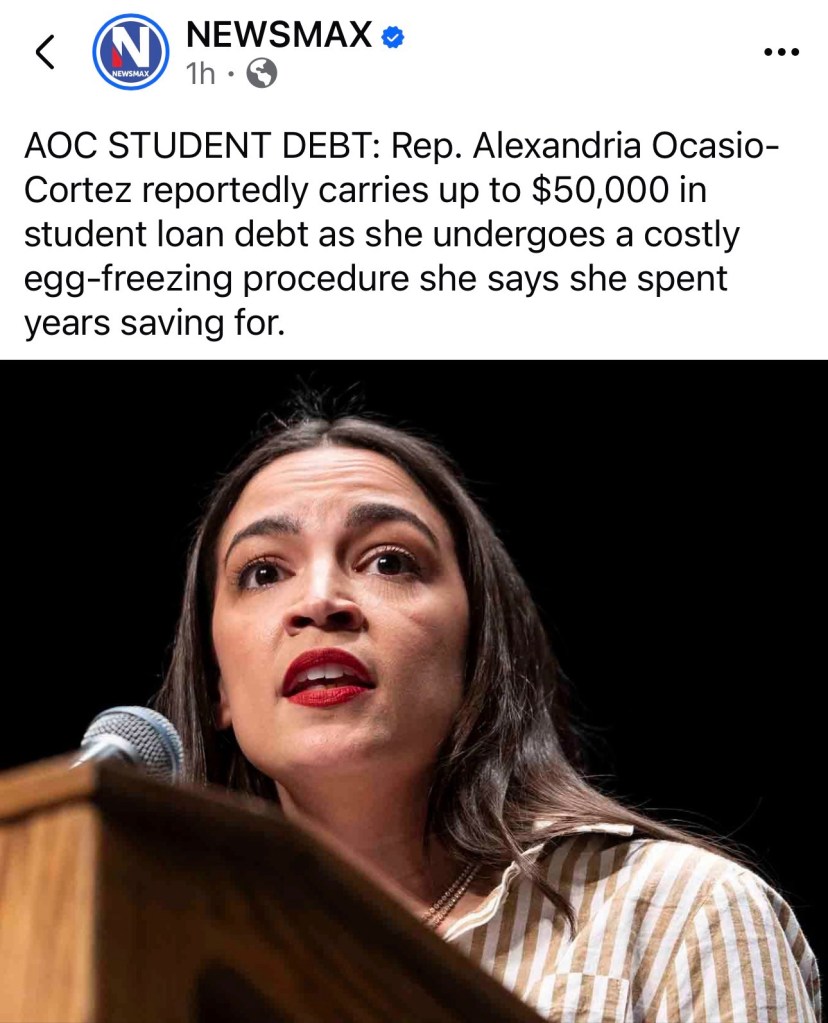
    Yesterday and again today, Newsmax posted a story about Alexandria Ocasio-Cortez having student-loan debt while choosing to freeze her eggs.

    And after reading hundreds of comments, I think the reaction to this story is far more interesting than the story itself.

    First, let’s talk about framing.

    Newsmax could have reported that a 36-year-old congresswoman publicly discussed freezing her eggs, something she says she spent years saving for, while talking about the realities women face when balancing careers, relationships, finances and fertility.

    Instead, the headline prominently juxtaposed two things: student-loan debt and an expensive fertility procedure.

    Why?

    Because putting those two facts next to each other invites the reader to make a judgment that the underlying facts don’t necessarily establish:

    She has debt, yet she’s spending money on this.

    And judging from the comment section, it worked beautifully.

    Suddenly people were claiming she doesn’t pay her student loans. That she’s waiting for taxpayers to pay them. That her wages should be garnished. That she’s financially irresponsible. That because she earns $174,000, she shouldn’t have debt at all.

    But where did those conclusions come from?

    Not from the mere existence of a student-loan balance.

    Having an outstanding loan does not mean someone is delinquent. A financial disclosure showing a balance doesn’t tell you the original amount borrowed, the interest rate, the repayment plan, the monthly payment, or how much principal and interest have already been paid.

    This is where media literacy matters.

    Ask yourself what the article actually established and what the framing encouraged you to assume.

    Then something even more revealing happened.

    The discussion stopped being about money.

    People began discussing whether she should reproduce. Whether her eggs were “fried.” Whether she waited too long. Whether anyone would want children with her. Her appearance. Her relationships. Her former job as a bartender.

    Think about that transition.

    We supposedly began with a story about student debt and personal spending, yet somehow hundreds of strangers ended up evaluating a woman’s fertility, desirability and worthiness to become a mother.

    That isn’t financial analysis.

    That’s misogyny.

    And more specifically, let’s talk about female misogyny, or what researchers generally call internalized misogyny.

    Some of the ugliest comments I read about this woman came from other women.

    Women mocking another woman’s fertility.

    Women reducing an accomplished elected representative with a bachelor’s degree in economics and international relations to “the bartender.”

    Women ridiculing another woman because she hasn’t had children on a timetable they consider acceptable.

    Women deciding that another woman’s reproductive choices somehow make her less intelligent, less respectable or less worthy.

    Being a woman does not make someone incapable of perpetuating misogyny.

    Women grow up in the same culture everyone else does. They can absorb the same stereotypes about what women are supposed to look like, when they’re supposed to marry, when they’re supposed to have children, how ambitious they’re allowed to be, and what makes a woman “valuable.” Research on internalized misogyny specifically examines how women can absorb sexist attitudes and direct contempt or disdain toward themselves and other women.

    And that’s what makes some of these comments worth examining.

    You don’t have to like Alexandria Ocasio-Cortez.

    You don’t have to agree with a single policy she supports.

    Criticize her votes. Challenge her economic arguments. Debate her policy proposals. Question her record. That’s politics.

    But when your political criticism becomes:

    She’s too old to have children.

    Nobody should reproduce with her.

    She’s just a bartender.

    Her eggs are fried.

    you’ve stopped discussing public policy.

    You’re policing a woman’s femininity, sexuality, fertility and social worth.

    And when women participate in that behavior against other women, we should be willing to call that out too.

    There’s another irony here.

    Americans constantly complain that politicians are wealthy, privileged and completely disconnected from ordinary people’s lives.

    Then a politician talks openly about having student debt, saving for years to afford something expensive, balancing a demanding career with personal goals, and making decisions about her future…

    and people ridicule her for being relatable to millions of Americans who do exactly those things.

    You cannot simultaneously demand politicians understand ordinary people’s financial lives and then shame one because her financial life doesn’t resemble that of a multimillionaire.

    So here’s my media-literacy challenge:

    The next time a headline makes you immediately angry, stop before commenting.

    Ask:

    What facts did the article actually establish?

    What did the headline merely imply?

    What information is missing?

    What assumptions am I filling in myself?

    And perhaps most importantly:

    Would I be making the same criticism if the person in the story were a man?

    Because sometimes the most revealing thing about a news story isn’t the story.

    It’s what the framing teaches the audience to talk about.

  • Facebook memories will humble you. 😂

    Facebook memories will humble you. 😂

    This popped up from 14 years ago, and I sat here looking at it thinking about how much my thinking has changed.

    At the time, I had no problem with drug testing people who received public assistance. My reasoning was pretty simple: people get drug tested for jobs, so why shouldn’t someone receiving taxpayer-funded assistance be tested too?

    And no, I didn’t believe everyone receiving assistance was using drugs. It just seemed like a reasonable requirement.

    But here’s what I wasn’t asking:

    How much does all that drug testing cost taxpayers?

    How many recipients actually test positive?

    How much money are we supposedly saving after paying to administer an entire testing program?

    And most importantly, even if somebody IS struggling with drug addiction, when did that mean they no longer deserve to eat?

    That’s the part that hits me differently today.

    We’re talking about people receiving a relatively small amount of assistance to buy FOOD. Not cash for a vacation. Not some luxurious lifestyle. Food.

    Addiction doesn’t eliminate hunger. Poverty doesn’t eliminate someone’s humanity. And children certainly shouldn’t go hungry because of something their parent may or may not have done.

    What’s interesting to me about this memory isn’t that I suddenly became smarter sometime during the last 14 years. It’s that I learned to ask more questions.

    The meme gave me a very simple fairness argument:

    “If workers have to take drug tests, welfare recipients should too.”

    And I accepted the premise without examining everything underneath it.

    Who created that framing?

    What does the actual data say?

    What does the policy cost?

    Does it accomplish what we’re being told it accomplishes?

    Who benefits from convincing us that another struggling person is the problem?

    That’s what media literacy does. It doesn’t tell you what political opinion you’re supposed to have. It teaches you to stop accepting somebody else’s premise before you’ve examined it.

    Sometimes growth is being able to look at something you posted 14 years ago and say:

    I understand exactly why that argument made sense to me then. I also understand why it doesn’t anymore.

  • The Reflecting Pool and the Reflection of Modern Media

    The Reflecting Pool and the Reflection of Modern Media

    Sometimes the most interesting story isn’t the event itself.

    It’s what people choose to believe about it.

    Over the past week, a simple maintenance problem at one of America’s most recognizable landmarks became something much larger. What began as reports of algae growth and peeling paint at the Lincoln Memorial Reflecting Pool quickly transformed into a full-blown online narrative war.

    Within hours, social media users were claiming sabotage.

    Some insisted activists had dumped chemicals into the water. Others claimed organized political groups were responsible. Posts spread rapidly, often accompanied by dramatic language, accusations, and certainty unsupported by evidence.

    At the same time, reporters from multiple news organizations were documenting something far less sensational: algae growth, peeling coating material, workers applying treatments to the water, and maintenance crews attempting to address the problem.

    The contrast was striking.

    One side of the internet was watching videos of people pulling large sheets of blue material from the pool and asking questions about construction quality, environmental conditions, and project management.

    The other side was constructing elaborate theories involving vandals, conspiracies, and political enemies.

    What happened next was even more interesting.

    The public began pushing back.

    Comment sections filled with questions that should have been asked from the beginning:

    Where is the evidence?

    Who was arrested?

    What chemicals were used?

    What proof exists that anyone intentionally damaged the pool?

    Why are we assuming sabotage before investigating ordinary explanations?

    Eventually, many conversations shifted from outrage to humor.

    The jokes became relentless.

    Photosynthesis was accused of being the real culprit.

    Algae became a suspect.

    Commenters joked that chemistry itself was being investigated.

    The humor revealed something important: people often recognize when a narrative is stretching beyond the available facts.

    The Reflecting Pool story illustrates a growing problem in modern media consumption. Too often, people begin with a conclusion and then search for evidence that supports it. Facts become secondary. Evidence becomes optional. Speculation becomes certainty.

    The result is a cycle where every event is immediately assigned a villain before anyone understands what actually happened.

    Sometimes vandalism is real.

    Sometimes corruption is real.

    Sometimes sabotage is real.

    But sometimes algae is simply algae.

    And sometimes a maintenance failure is just a maintenance failure.

    The lesson isn’t about a reflecting pool.

    It’s about how quickly stories evolve online and how easily assumptions can outrun evidence.

    In an era where information travels faster than facts, the most valuable question remains the simplest one:

    “What’s the evidence?”

  • The Age of Spectacle: Why Everything Has Become a Stunt

    The Age of Spectacle: Why Everything Has Become a Stunt

    A giant inflatable depicting Elon Musk appeared in Times Square ahead of SpaceX’s IPO. Some people laughed. Others were outraged. News outlets covered it. Social media amplified it. Millions of people who otherwise would have ignored the debate suddenly had an opinion.

    Whether you agreed with the message is almost beside the point.

    The inflatable did exactly what it was designed to do: capture attention.

    We live in an age where attention has become one of the most valuable commodities in the world. Politicians know it. Corporations know it. Activists know it. Media outlets know it.

    The modern battle is no longer simply over policy. It is over visibility.

    A century ago, governments relied on newspapers, radio broadcasts, and public rallies to shape public opinion. Today, the tools are different, but the objective remains the same. Viral clips replace newsreels. Algorithms replace newspaper editors. Giant inflatables replace political posters.

    The people protesting Elon Musk understand the same lesson that Elon Musk himself understands: if you want to influence public conversation, you must first command public attention.

    This is why modern politics increasingly resembles entertainment.

    Presidential campaigns become reality television. Billionaires become celebrities. Activists become influencers. News becomes content. Outrage becomes engagement.

    The result is a society where symbolism often travels farther than substance.

    A giant inflatable can generate more discussion than a thousand-page policy proposal. A meme can reach more people than a congressional hearing. A viral video can shape public opinion faster than a detailed investigative report.

    None of this means the underlying issues are unimportant. Questions about artificial intelligence, corporate responsibility, taxation, wealth concentration, government spending, and public accountability deserve serious discussion.

    But serious discussion rarely goes viral.

    Spectacle does.

    The inflatable in Times Square is not the story. It is a symptom.

    The real story is that we now live in a culture where every side—politicians, corporations, activists, media personalities, and ordinary citizens—is competing in the same attention economy.

    The winners are not always those with the strongest arguments.

    Often, they are simply the ones who create the most memorable image.

    Conditioning Through Headlines: How We Learn to Fear Entire Groups