Sometimes the most interesting story isn’t the event itself.
It’s what people choose to believe about it.
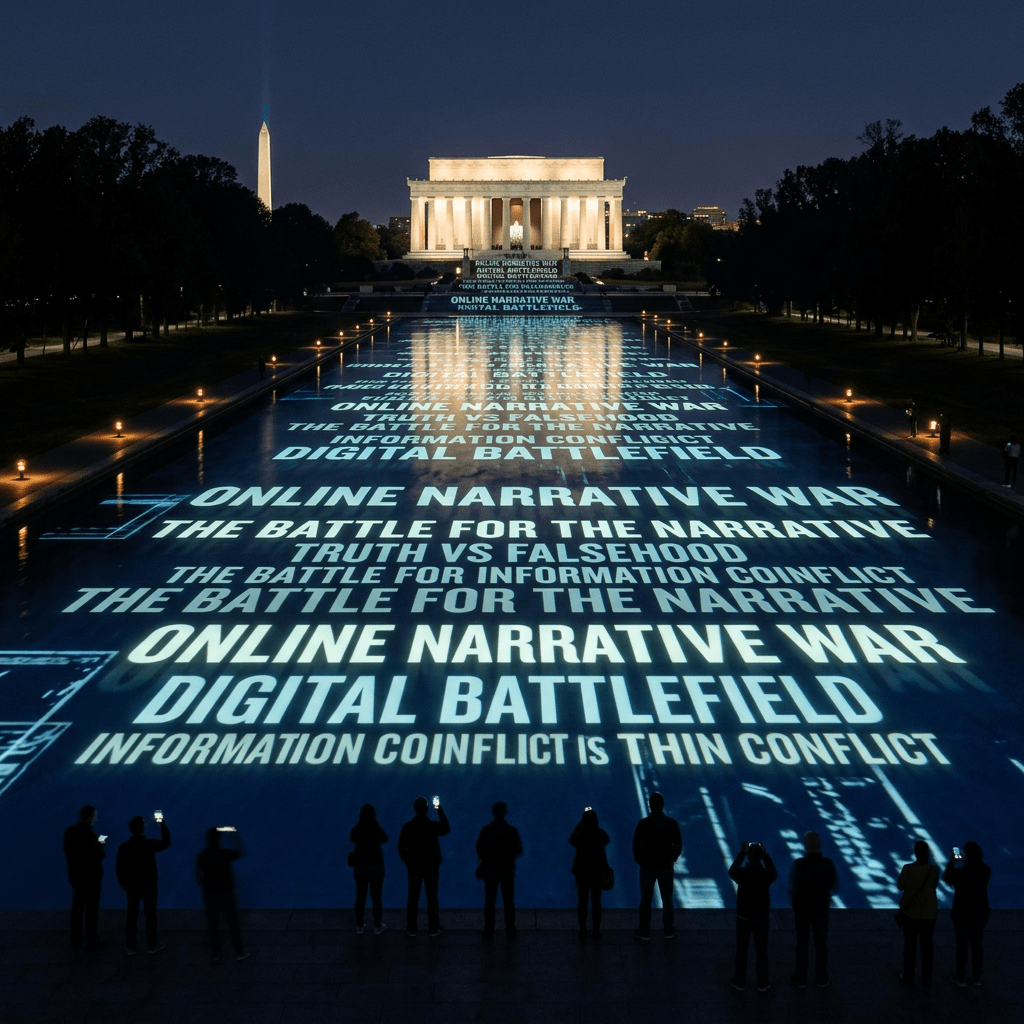
Over the past week, a simple maintenance problem at one of America’s most recognizable landmarks became something much larger. What began as reports of algae growth and peeling paint at the Lincoln Memorial Reflecting Pool quickly transformed into a full-blown online narrative war.
Within hours, social media users were claiming sabotage.
Some insisted activists had dumped chemicals into the water. Others claimed organized political groups were responsible. Posts spread rapidly, often accompanied by dramatic language, accusations, and certainty unsupported by evidence.
At the same time, reporters from multiple news organizations were documenting something far less sensational: algae growth, peeling coating material, workers applying treatments to the water, and maintenance crews attempting to address the problem.
The contrast was striking.
One side of the internet was watching videos of people pulling large sheets of blue material from the pool and asking questions about construction quality, environmental conditions, and project management.
The other side was constructing elaborate theories involving vandals, conspiracies, and political enemies.
What happened next was even more interesting.
The public began pushing back.
Comment sections filled with questions that should have been asked from the beginning:
Where is the evidence?
Who was arrested?
What chemicals were used?
What proof exists that anyone intentionally damaged the pool?
Why are we assuming sabotage before investigating ordinary explanations?
Eventually, many conversations shifted from outrage to humor.
The jokes became relentless.
Photosynthesis was accused of being the real culprit.
Algae became a suspect.
Commenters joked that chemistry itself was being investigated.
The humor revealed something important: people often recognize when a narrative is stretching beyond the available facts.
The Reflecting Pool story illustrates a growing problem in modern media consumption. Too often, people begin with a conclusion and then search for evidence that supports it. Facts become secondary. Evidence becomes optional. Speculation becomes certainty.
The result is a cycle where every event is immediately assigned a villain before anyone understands what actually happened.
Sometimes vandalism is real.
Sometimes corruption is real.
Sometimes sabotage is real.
But sometimes algae is simply algae.
And sometimes a maintenance failure is just a maintenance failure.
The lesson isn’t about a reflecting pool.
It’s about how quickly stories evolve online and how easily assumptions can outrun evidence.
In an era where information travels faster than facts, the most valuable question remains the simplest one:
“What’s the evidence?”


Leave a comment