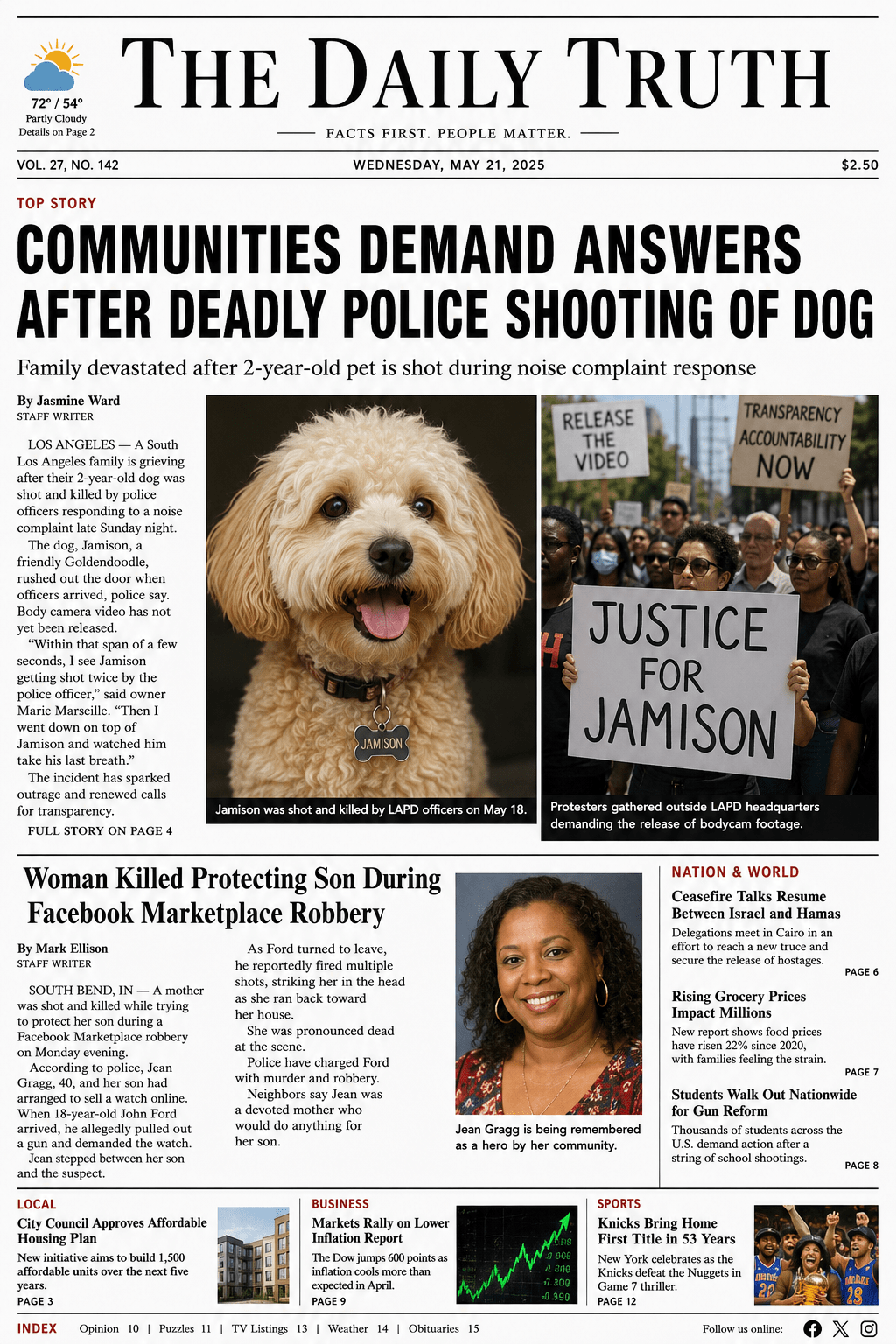
Most people believe propaganda is obvious.
They imagine government posters, staged rallies, or television broadcasts telling citizens exactly what to think. They assume they would recognize it immediately.
The reality is far more subtle.
Today, conditioning often arrives one headline, one viral post, and one comment section at a time.
Over the last several years, I have noticed a pattern that repeats itself across social media. A crime occurs. The victim and suspect are immediately identified by race, religion, nationality, or immigration status. The story spreads rapidly, often accompanied by emotional language designed to provoke outrage.
“A White mother killed by a Black robber.”
“An illegal immigrant accused of assault.”
“A Muslim suspect.”
“A Somali gang.”
The details change, but the formula remains the same.
The tragedy itself becomes secondary. The focus shifts to the identity of the people involved.
What makes this so effective is that no one has to explicitly tell you to hate anyone.
Nobody says, “You should fear Black people.”
Nobody says, “You should distrust immigrants.”
Nobody says, “You should be suspicious of Muslims.”
Instead, you are shown the same association repeatedly until your brain begins making the connection on its own.
Psychologists call this availability bias. We tend to judge the frequency of something based on how easily examples come to mind. If every crime story you see highlights a suspect’s race or immigration status, you begin to believe those characteristics are central to the problem—even when statistics may not support that conclusion.
The process works because it feels like you reached the conclusion yourself.
Meanwhile, thousands of crimes that do not fit the preferred narrative receive little attention. Murders happen every day. Assaults happen every day. Robberies happen every day. Yet only a handful become national stories.
Why?
Often because they can be used to reinforce an existing narrative.
The result is that entire communities become associated with crimes committed by individuals.
A teenager commits a robbery.
Suddenly people are discussing an entire race.
One immigrant commits a crime.
Suddenly millions of immigrants are viewed with suspicion.
One person behaves terribly.
An entire group is expected to answer for it.
Imagine applying that standard consistently. Every White person would be judged by the actions of the worst White criminal. Every Christian would be judged by the actions of the worst Christian. Every police officer would be judged by the worst officer. Every immigrant would be judged by the worst immigrant.
Most of us recognize immediately how unfair that would be.
Yet we often fail to notice when the same logic is applied to groups we already view as outsiders.
This is why media literacy matters.
When you see a headline, ask yourself:
Would this still be a story if the races were reversed?
Would this still be a story if immigration status were omitted?
Would this still be a story if the religion were never mentioned?
Most importantly:
Am I being informed, or am I being conditioned?
There is a difference between reporting facts and encouraging fear.
Facts help us understand reality.
Fear encourages us to see enemies everywhere.
Every victim deserves justice. Every family deserves compassion. But when tragedies are selectively amplified to create suspicion toward entire groups of people, the conversation is no longer about the victim.
It becomes about manufacturing division.
History shows us where that road leads.
The most dangerous propaganda is rarely the kind that demands hatred outright.
It is the kind that quietly teaches it, one story at a time, until people no longer recognize they are being taught.
When Reporting Isn’t Enough: Why Context Matters More Than Ever


Leave a comment