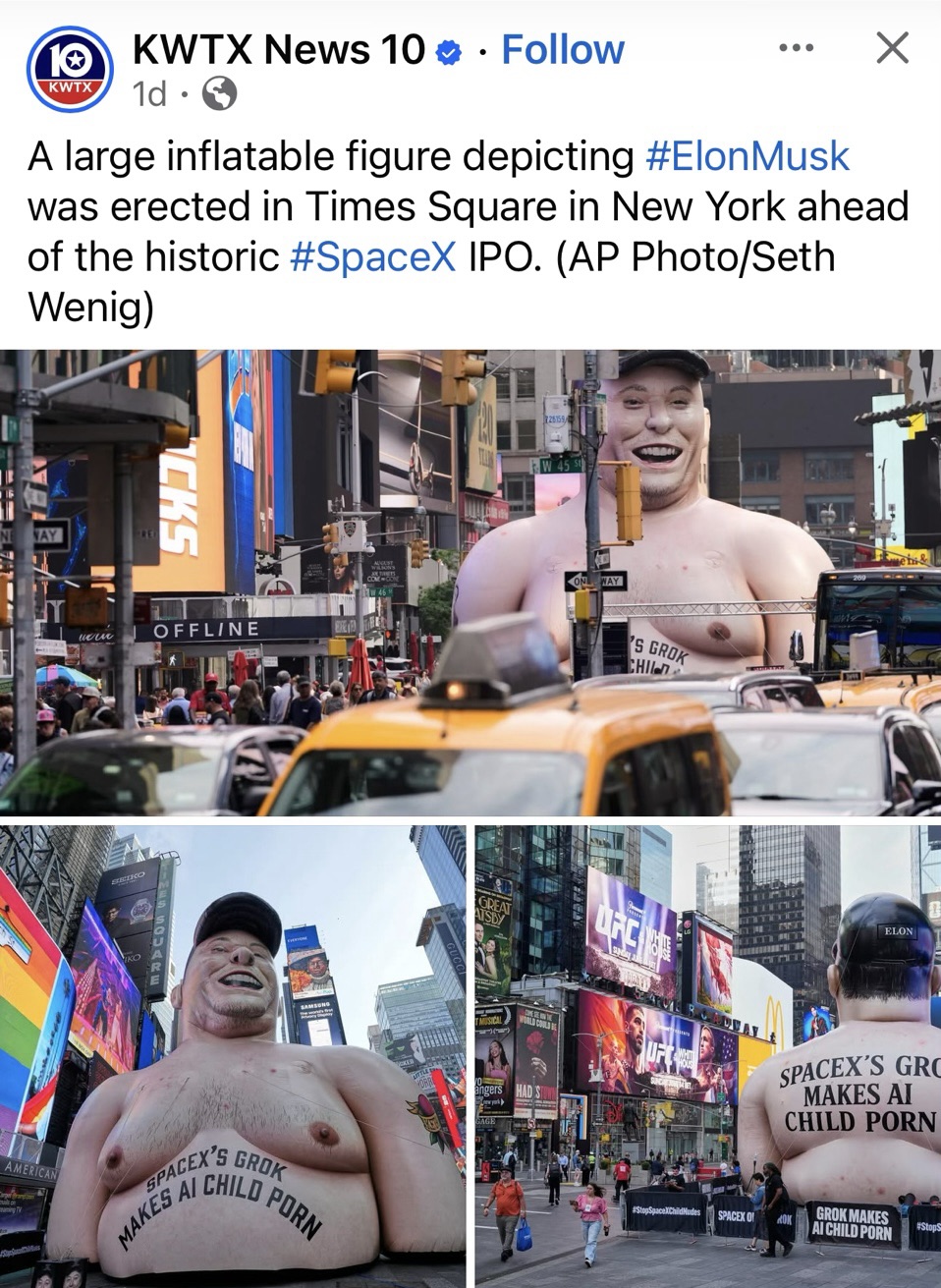
A giant inflatable depicting Elon Musk appeared in Times Square ahead of SpaceX’s IPO. Some people laughed. Others were outraged. News outlets covered it. Social media amplified it. Millions of people who otherwise would have ignored the debate suddenly had an opinion.
Whether you agreed with the message is almost beside the point.
The inflatable did exactly what it was designed to do: capture attention.
We live in an age where attention has become one of the most valuable commodities in the world. Politicians know it. Corporations know it. Activists know it. Media outlets know it.
The modern battle is no longer simply over policy. It is over visibility.
A century ago, governments relied on newspapers, radio broadcasts, and public rallies to shape public opinion. Today, the tools are different, but the objective remains the same. Viral clips replace newsreels. Algorithms replace newspaper editors. Giant inflatables replace political posters.
The people protesting Elon Musk understand the same lesson that Elon Musk himself understands: if you want to influence public conversation, you must first command public attention.
This is why modern politics increasingly resembles entertainment.
Presidential campaigns become reality television. Billionaires become celebrities. Activists become influencers. News becomes content. Outrage becomes engagement.
The result is a society where symbolism often travels farther than substance.
A giant inflatable can generate more discussion than a thousand-page policy proposal. A meme can reach more people than a congressional hearing. A viral video can shape public opinion faster than a detailed investigative report.
None of this means the underlying issues are unimportant. Questions about artificial intelligence, corporate responsibility, taxation, wealth concentration, government spending, and public accountability deserve serious discussion.
But serious discussion rarely goes viral.
Spectacle does.
The inflatable in Times Square is not the story. It is a symptom.
The real story is that we now live in a culture where every side—politicians, corporations, activists, media personalities, and ordinary citizens—is competing in the same attention economy.
The winners are not always those with the strongest arguments.
Often, they are simply the ones who create the most memorable image.
Conditioning Through Headlines: How We Learn to Fear Entire Groups


Leave a comment